For dentists, physical therapists, medspas & wellness clinics
Be the Local Healthcare & Wellness Practice AI Recommends
Turn ChatGPT, Perplexity, Gemini, and Copilot into a growing source of new patient inquiries and appointment bookings.
Help patients and clients find your practice when they ask AI about local dentists, physical therapy, chiropractic care, and medspa treatments. BlueJar shows where you appear, checks how your practice is described, and makes improvements with your approval.
Get your free practice snapshot
See where AI names your practice, who appears instead, and what to fix first.
The current landscape
Clients Are Using AI to Choose Local Dentists, Specialists, and Wellness Spas
of US adults turned to AI chatbots for health information in the past year
KFF, Mar 2026 (1,343 US adults)
of patients searching for a doctor say AI tools influence their choice, ahead of Google search (34%) and doctor recommendations (32%)
rater8, 2026 (nearly 1,000 US adult patients)
of patients would not book with a provider rated below 4.0 stars
rater8, 2026
of US consumers use ChatGPT or other generative AI tools for local business recommendations, up from 6% a year earlier
BrightLocal, 2026 (1,002 US adults)
The difference
Traditional Medical & Wellness Marketing vs. AI-Ready Practice Visibility
| Traditional Medical & Wellness Marketing | AI-Ready Practice Visibility |
|---|---|
| Practitioner Bios & Health Blogsbuilt for readers and traditional search | Structured Provider & Service Schemaeasily ingested by LLM crawlers |
| Generic Local SEOtargeting broad zip codes | Specialized Treatment Contextanswering specific procedure and wellness queries |
| Paid Local Advertisingrequiring ongoing campaign spend | Visibility in AI Answerswhen high-intent patients and clients ask AI where to book |
| Fragmented Directory Listings | Monthly Re-Testingacross ChatGPT, Perplexity, Gemini, and Copilot |
The process
From understanding your practice to approved improvements
Understand your practice and ideal patients
We map your specialties, treatments, ideal patients and clients, their priorities, and the moments that make them start looking. You review that picture and the sample questions before we test your AI visibility.
Free snapshot
- Brand overviewDental specialties, provider credentials, core services, accepted insurance, service area, and local competitors.From your website & licensing registries
- PersonasFamilies seeking routine dental care, adults exploring cosmetic dentistry, and patients needing emergency appointments.6 client personas
- PrioritiesProvider credentials, treatment options, insurance and pricing clarity, and appointment availability.8 client priorities
- TriggersA dental concern, an upcoming routine checkup, a change in insurance, or moving to the area.15 booking triggers
- PromptsRealistic sample questions built from your dental services and your patients’ journey.30 sample questions
You review and edit this picture, and the sample questions, before anything is tested.
Sample questions by practice type
Every snapshot uses questions built for that practice’s own services. Examples for four practice types:
- Dental
- “Find top-rated family dental practices near Springfield, NJ accepting Delta Dental for same-week emergency care.”
- Physical therapy
- “Who is the best out-of-network sports physical therapist in Springfield, NJ specializing in ACL rehab?”
- Chiropractic
- “Which chiropractors in Springfield, NJ offer non-invasive care for chronic lower back pain?”
- MedSpa & wellness
- “Which top-rated medspas in Springfield, NJ offer licensed nurse practitioner consultations for laser skin resurfacing and IV therapy?”
Benchmark your visibility against other practices
We test those questions in ChatGPT, Gemini, Perplexity and Copilot and show where your practice is named, by patient type, alongside the practices AI names instead.
Free snapshot
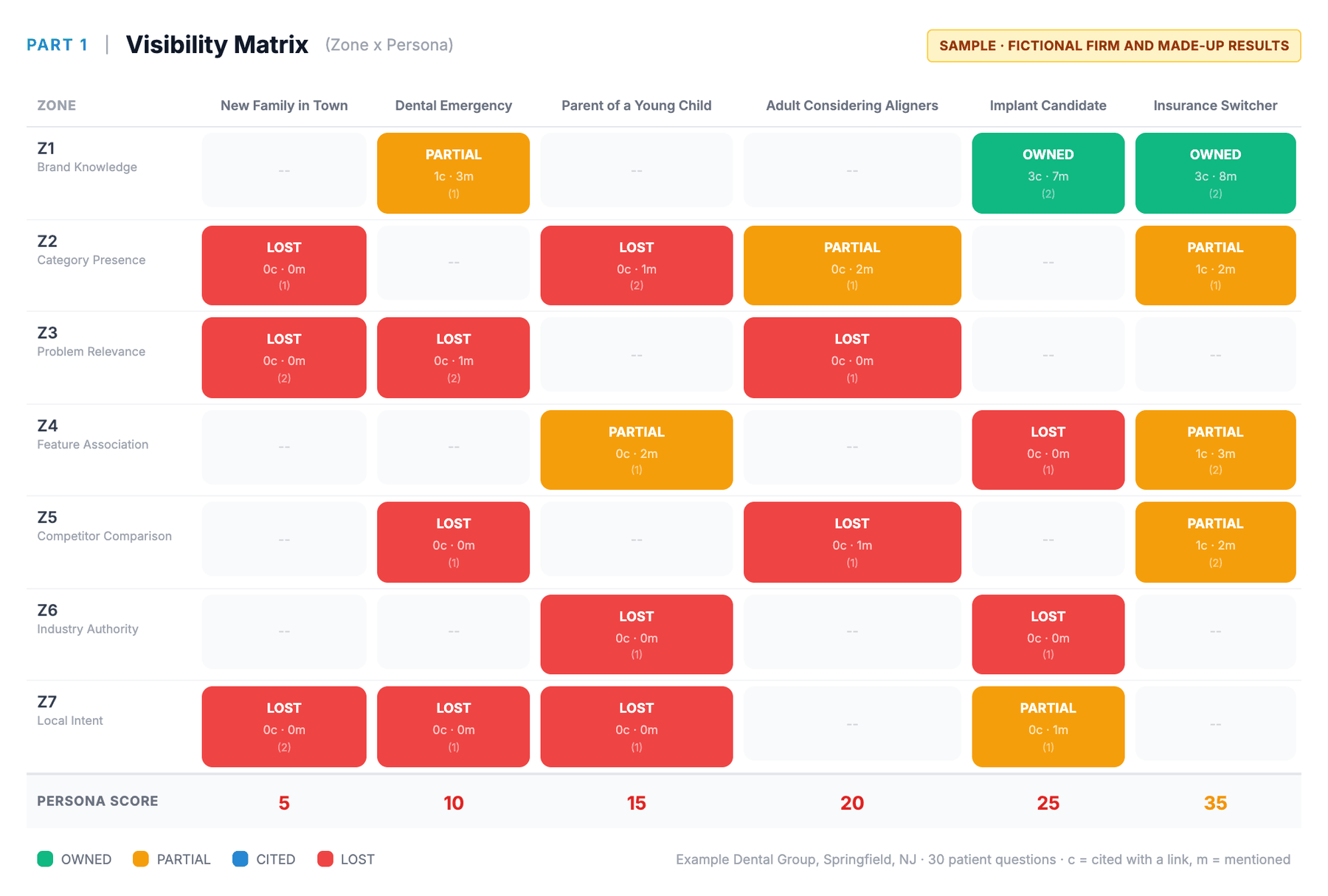
Sample with a fictional firm and made-up results. The layout is the app’s Visibility Matrix. Enlarge Check AI descriptions against your website and listings
We compare sampled AI descriptions of your providers, treatments, accepted insurance, hours and location with your website, listings and public licensing records, and flag differences we find in the sampled answers.
Free snapshot: first fixes · Full plan with ongoing service
- Website
- Accepting new patients
- Google listing
- Accepting new patients
- One AI answer
- “not accepting new patients”
StatusDifference flagged for your review
In this sample, 19 of 20 sampled answers that named the practice described it correctly.
Make approved improvements and measure progress
After your approval, we make the website and listing improvements, then re-test the same questions each month.
Ongoing service (paid)
6 Fixes to Improve AI Visibility (first 4 shown)
- Correct the new-patient statusOne profile says the practice is not accepting new patients. Match the website: it is.P1
- Complete provider profilesFill in treatments, provider licenses and accepted insurance on the profiles the practice already has.P1
- Answer local patient questionsA same-week emergency visit page for Springfield and nearby towns.P2
- Structured data on key pagesMarkup that tells AI tools what the practice treats and who it serves.P2
Roadmap
- FirstP1 fixes, after your approval
- NextP2 fixes, after your approval
- ThenSame prompts re-run each month
See what changed each month
Track where you appear, how you are described, which approved improvements were completed, and what to address next.
Approval and control
Your practice stays in control
Checked, reviewed, and approved by you.
You approve every change
Nothing goes live until you approve it.
Checked against your public records
We flag where sampled AI answers differ from your website, listings and public licensing records.
A record of what changed
Findings, approved changes, and items awaiting review.
What you receive
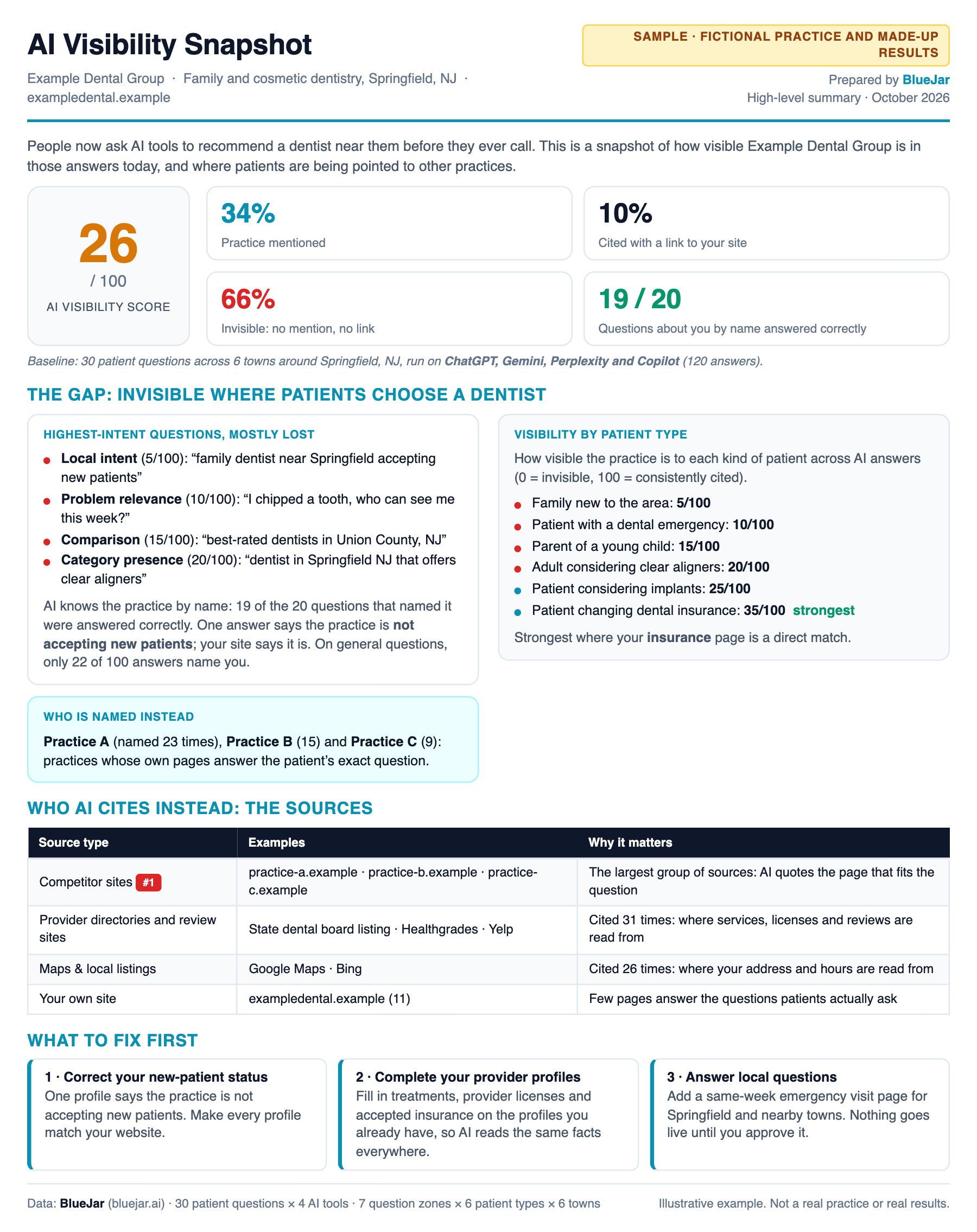
Your practice snapshot, in three parts
Treatment and local visibility
Where AI names your practice for the treatments you offer, town by town and by patient type.
Accuracy of your practice’s description
Whether AI states your providers, credentials, treatments, accepted insurance, hours and location correctly, checked against your website and listings.
Who is named instead, and what to fix first
The practices and directories AI points patients to, and a short, prioritized list of fixes.
Ongoing service
Approved improvements. Monthly measurement. Clear next steps.
Your free snapshot shows where your practice stands and what to fix first. With an ongoing plan, we make the approved improvements included in your scope, re-test the agreed questions each month, and use the findings to prioritize the next changes.
From $99/month
No setup fee.
Your plan is tailored to your website, target markets, and the improvements needed. We confirm your recommended monthly price and included scope after reviewing your practice, before you subscribe.
Implementation and testing coverage depend on the plan you select.
Start with your free snapshotFAQ
Questions practices ask
Who is this page for?
Independent and group practices: dental and orthodontic offices, physical therapy and sports rehab clinics, chiropractors, and medspas and wellness spas.
What will my free snapshot include?
What ChatGPT, Gemini, Perplexity and Copilot say when patients ask for a practice like yours: where you appear, who is named instead, whether your practice is described correctly, and what to fix first. It is a report sent by email, within 2 business days of your reply to our confirmation email.
Do you need patient data?
No. Everything we look at is public: your website, your listings, public licensing records and what AI tools say. We never need patient records or protected health information.
Who approves the content?
You do, always. We work from your website, your listings and public licensing records, and we don’t write treatment outcome claims. BlueJar doesn’t give medical, legal or compliance advice.
Do you make the improvements for me?
Yes, within a paid monthly plan. Our team makes the website and listing changes included in your plan’s agreed scope, and you approve each one before it goes live. Larger projects are scoped and priced separately before any work begins. The free snapshot itself is a report only.
How much does ongoing service cost?
Your AI visibility snapshot is free. Monthly plans start at $99, with no setup fee. Your recommended plan depends on your website, target markets, and the scope of improvements. We confirm the monthly price, included work, and any additional project costs before you subscribe.
Can you guarantee more patients or AI recommendations?
We improve your website and practice information, then test and refine monthly to strengthen AI visibility and create more opportunities for inbound leads. Results aren’t guaranteed, but each step is guided by measured progress.
Is this lead generation?
BlueJar supports inbound lead generation by helping your business get discovered and accurately represented in AI answers. We identify visibility gaps, make improvements with your approval, and track progress over time. We don’t buy or sell leads, and we can’t guarantee inquiries or sales.
The opportunity is promising: Semrush’s 2025 study found that AI search visitors were 4.4× as valuable as traditional organic search visitors, based on conversion rate. AI tools can help buyers research and compare options before visiting your website, so those visitors may arrive better prepared to take the next step.
The research focused on digital marketing and SEO topics. It supports the opportunity, but isn’t a forecast for your business; results vary.
First-mover advantage
AI answers name only a few practices. Be one of them first.
AI search is still new for local practices, and it rewards the ones that move early. See where your practice stands in your market before the practice down the street looks.
No one can guarantee AI recommendations or bookings. We show where you stand, fix what is in your control, and measure the change.
Get your free practice snapshot
See where AI names your practice, who appears instead, and what to fix first.